Reflective Writing for Voting Project
Quantitative literacy is very important and probably one of the most applicable kinds of mathematics that could be used in daily life. There are many different 'story problems' and ways of analyzing data in day-to-day life. From understanding which options may save you money in the long run, how interest rates in finances have such an impact, and different ways to interpret and represent data best depending on context.
The project I'm focusing on for my signature assignment reflection is in regards to voting theory. Voting theory could be used to help determine the most appropriate option depending on: the event, choices available, and voters.
For example, even in a situation as simple as choosing a nice restaurant to eat at with coworkers. Most people might just go with the plurality method to decide. (Which means the first choice with the most votes wins.) This is how most basic poll results are determined. Which can be simple and efficient if there are many voters or participants.
In some cases however, you may have more options than voters participating. In an instance like this it may be more appropriate to use a method such as the Borda Count method. Which assigns voters multiple choices that they decide by most preferred to least preferred. With this method each choice tier is tallied, weighted, and scored. This method I believe, really shows a true consensus in terms of choice and overall approval that can often yield a better outcome.
Striving for fairness within a certain context regarding voting theory to make the best decision; understanding personal finance outcomes and calculations, to truly becoming literate when it comes to mathematics that is applied in everyday life. My Quantitative literacy class has prepared me to put the math into my own hands.
Section I:
Caucuses were the original method of selecting delegates and is a process which chooses the states
delegates with each party’s national convention and where presidential nominee is formally selected. A
political party organizes the date, time, and location, and any voter registered can attend and cast a vote
for who they want in a particular office. It begins on February 1 and is held in 1,681 precincts in Iowa. A
primary election was a movement to entrust more power to citizens in the candidate’s party. During a
primary election any registered voter can participate by voting on a secret ballot at a precinct same as with
the general election.
Republicans and Democrats have different ways of casting their votes. Republicans cast a secret ballot
which are counted and reported to the state party. The totals gathered on caucus night are “normal” vote
tallies as with any other election.
Democrats divide a number of delegates based upon turnout from the past 2 elections; similar to
electoral college on micro level. It begins with electing people to county, which elects people to district,
which elects people to state. Once the Democrats arrive they are divided among one another based upon
which candidate they support. It is then counted how many supporters each candidate has. In order to be
successful a candidate historically needs 15% of votes from attendees. If their candidate does not succeed
they must support a candidate with enough votes, and a second vote is counted.
The Iowa caucus is an important asset in the presidential elections because they are an early
indicator of who might win the nomination at the national convention and who may not stand a chance. It
also limits the field and some candidates will drop out if they do badly at the caucus. Since 1972 Iowa has
played a major role of importance with the election.
Section III:
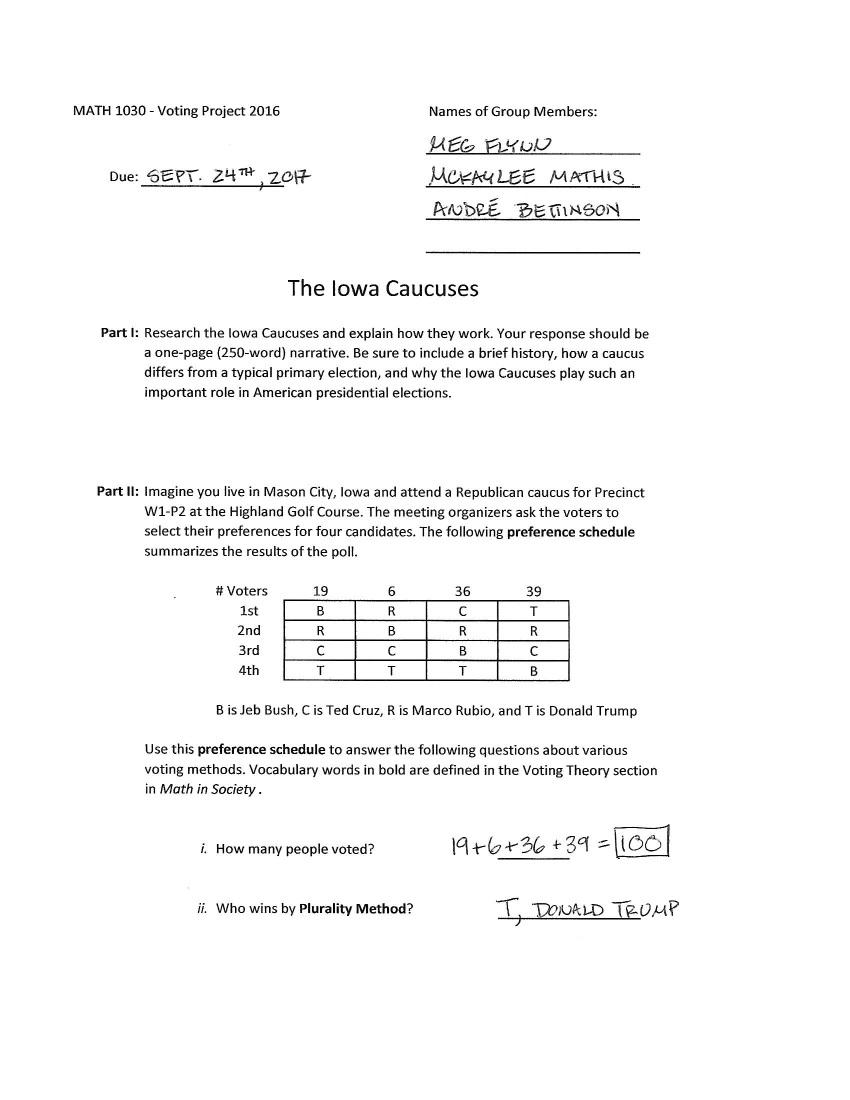
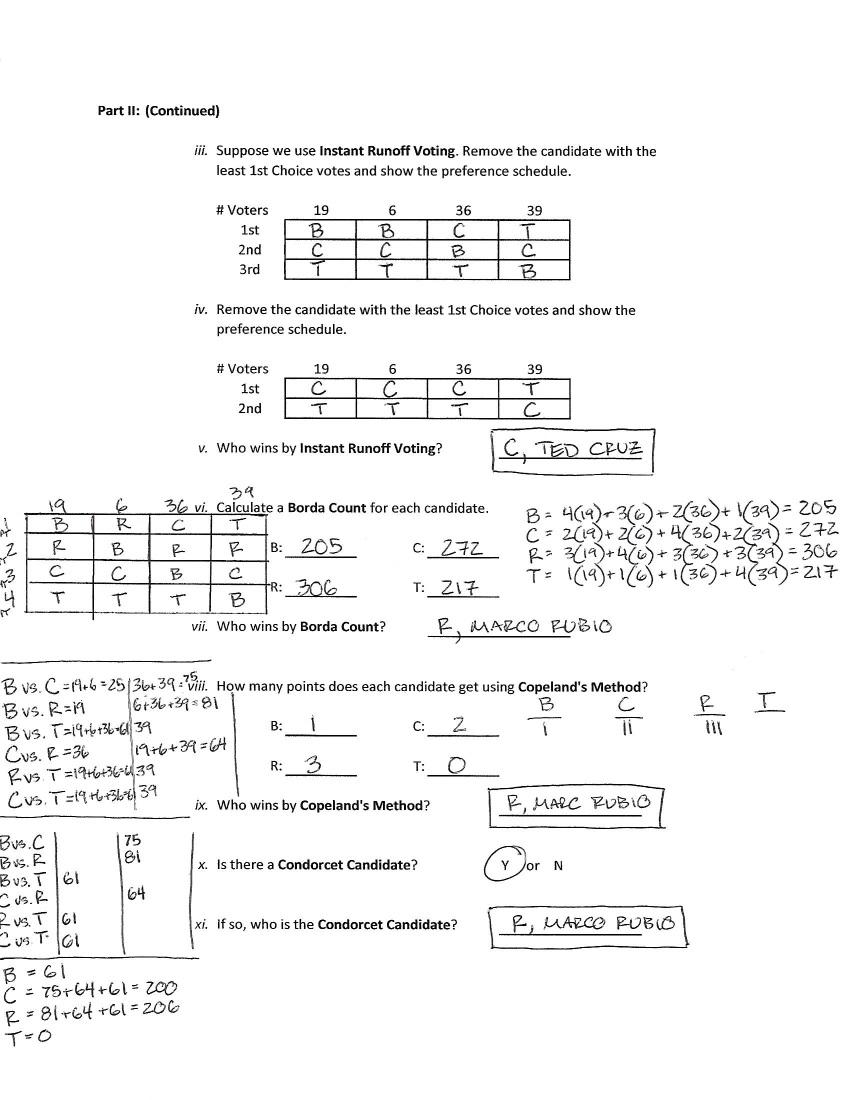
As the 3 delegates from Precinct W1-P2 in the Iowa Caucuses; we interpret the winner to be Marco
Rubio.
We come to this conclusion by using the Borda Count methods and Copeland's Method.
We are utilizing Copeland's Method to draw comparisons between each candidate in efforts to satisfy the
majority of opinion in approval overall, as well as to satisfy monotonicity criterion to show true
favorability if a re-election were held. This method shows the most head-to-head wins despite the other
candidate’s participation.
Utilizing Copeland's Method in addition to the Borda Count, which overall votes are weighted by
favorability, we have also determined Marco Rubio to be the winner. The Borda Count method also
satisfies the monotonicity criterion. This method usually doesn't favor a Condorcet candidate (one who
wins all of their matchups), however in this case Marco Rubio wins as a Condorcet Candidate using
Copeland's method, and he wins the Borda Count method overall.
In an instance where utilizing the plurality method to be a deciding factor, where the winner
would only have won 39% of first place votes, with the runner-up winning 36%, this is much too close to
make a decision to unify the party and show a true representation to yield the highest approval with our
candidate across all supporters who make up our precinct and state. This candidate barely wins the
plurality vote against three others; but doesn't win a single match-up if he were to go one-on-one with the
other candidates, we need to analyze and make a decision that best reflects our party as a whole.